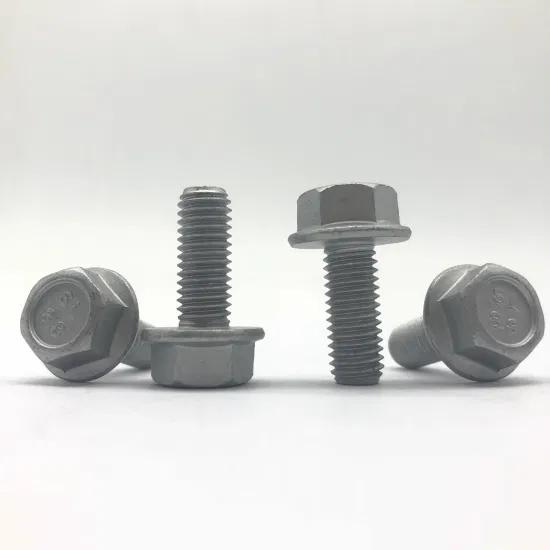
Hot-dip galvanizing has been the default corrosion protection for structural and renewable-energy fasteners for decades. It is cheap, robust and familiar to site crews. But on modern wind-turbine towers, photovoltaic tracking systems and solar tracker linkages, HDG has two problems that have pushed specifiers toward a different coating: hydrogen embrittlement on high-strength 10.9 / 12.9 bolts, and a coating thickness that consumes the thread allowance and makes nut fit unpredictable.
Zinc-flake coatings — commonly sold under trade names such as Geomet, Delta-Protekt, Magni and Zintek — were developed specifically to solve those two problems. They are thin, solvent-based, baked-on flake-zinc coatings that deliver 500–1000 hours of neutral salt-spray protection on high-strength fasteners without the acid-pickling step that drives hydrogen into steel.
WF Fastener supplies zinc-flake coated 10.9 and 8.8 bolts, studs, nuts and custom fasteners for wind-turbine bolted joints, solar mounting structures, tracker drives and BESS racking across Europe, the Middle East, Southeast Asia and Australia. This guide explains how zinc-flake coatings work, where Geomet and Delta-Protekt differ, what ISO 10683 actually requires, and what to put on an RFQ so the coating you receive is the coating the turbine OEM or solar tracker spec calls for.
For the broader renewable-energy fastener range, see our renewable-energy fastener manufacturer center. For comparison with the older galvanized route, see our hot-dip galvanized fastener guide to ISO 10684 / ISO 1461. For the tower flange joint this coating often protects, see our wind tower bolts to EN 14399 guide.
WF Zinc-Flake Quick Reference
- Coating family: Water-based zinc-flake / zinc-aluminum flake, no Cr(VI)
- Product standard: ISO 10683 — non-electrolytically applied zinc flake coatings
- Typical coating thickness: 8–20 µm depending on system
- Salt spray (ISO 9227 NSS): 500–1000+ hours to red rust
- Base fastener: 8.8 / 10.9 / 12.9 alloy steel per ISO 898-1
- Hydrogen risk: Low — no acid pickling, no electroplating
- Friction coefficient: Controlled 0.10–0.16 per OEM specification
- Typical products: Wind-tower flange bolts, foundation anchor threads, solar clamp bolts, tracker linkage bolts
1. Why Zinc-Flake Replaced HDG on High-Strength Bolts
A wind turbine or solar tracker joint is not the same problem as a transmission tower. Three engineering differences drive the switch.
1.1 High strength means hydrogen risk
Class 10.9 and 12.9 bolts have tensile strengths of 1040 MPa and above. At that hardness level, hydrogen pickup during acid pickling or electroplating can lead to delayed brittle cracking months after installation. Hot-dip galvanizing requires acid cleaning before dipping, and the baking-out cycle that follows is not always enough on ultra-high-strength parts. Zinc-flake coatings are applied by dip-spin or spray onto pre-cleaned, pre-baked parts with no acid step in the coating process itself. The hydrogen risk drops dramatically.
1.2 Thin coating preserves thread fit
HDG adds 50–85 µm of zinc. On an M36 10.9 bolt, that thickness is enough to consume the thread tolerance and force nuts to be tapped oversize — which means the bolt and nut have to travel as a matched set and cannot be swapped on site. Zinc-flake adds 8–20 µm. Thread gauges typically still pass after coating, and standard Class 6g / 6H thread fit is maintained.
1.3 Controlled friction matters on preloaded joints
Wind-turbine flange bolts and solar tracker pivot bolts are preloaded to a high percentage of yield. The torque you read on a wrench only relates to preload through the nut factor (k), which is dominated by thread and bearing-surface friction. HDG gives a wide, variable k. Zinc-flake systems are formulated with a defined friction range — commonly 0.10–0.16 — which lets the turbine engineer calculate torque once and trust it on every bolt.
2. How a Zinc-Flake Coating Is Applied
The process is simpler than hot-dip galvanizing and closer to a high-performance paint line.
- Cleaning. The fastener is degreased and shot-blasted or otherwise cleaned to remove oil and mill scale. No strong acid pickle.
- Pre-treatment. A conversion coating may be applied depending on the system.
- Coating application. Parts are dip-spun (dipped in the coating slurry, then centrifuged to remove excess) or spray-coated in baskets.
- Curing. Parts go into an oven at 200–320 °C for 20–60 minutes. The water carrier evaporates, the organic binder cross-links, and zinc and aluminum platelets flatten and overlap like shingles.
- Optional topcoat. A sealing topcoat — clear, black or colored — is applied and re-cured for extra corrosion resistance, chemical resistance or a defined friction coefficient.
The overlapping flake structure is why the coating works. Corrosion has to follow a long, tortuous path through the zinc platelets, and the zinc sacrificially protects the steel even where the coating is scratched.
The whole cycle is cool enough not to temper a properly quenched-and-tempered 10.9 bolt, which is why the coating process itself does not pull the bolt out of mechanical specification.
3. Geomet vs Delta-Protekt: Trade Names, Not Different Physics
Buyers new to zinc-flake often ask whether Geomet and Delta-Protekt are different coating families. They are not — they are competing brand systems built on the same zinc-flake chemistry.
| Feature | Geomet (NOF / MBI) | Delta-Protekt (Dörken) |
|---|---|---|
| Base chemistry | Zinc / aluminum flake, Cr(VI)-free water-based | Zinc / aluminum flake, Cr(VI)-free water-based |
| Typical systems | Geomet 500B, Geomet 321A, Geomet 720 | Delta-Protekt VL 370, Delta-Protect KL 100, Delta-Col series topcoats |
| Topcoat options | Geecan (sealer), wax / friction modifiers | Delta-Col, Delta-Seal, and friction-control topcoats |
| Typical salt spray | 500–1000+ hours to red rust depending on system | 500–1000+ hours to red rust depending on system |
| Friction control | Formulated topcoats to 0.10–0.16 µ | Formulated topcoats to 0.10–0.16 µ |
| Common use in wind | Tower flange bolts, foundation bolts | Tower flange bolts, rotor hub bolts, bearing bolts |
Other names you will see on turbine OEM specifications — Magni 565, Magni 700, Zintek 500, Geomet plus Geecan — are variations on the same theme. The specification rarely cares which trade name is printed on the box; it cares about:
- Coating thickness range
- Salt-spray hours to red rust
- Friction coefficient window
- Cr(VI)-free confirmation
- Approval by the turbine or tracker OEM
When we quote a zinc-flake bolt package, we match the system to the OEM's approved coating list rather than pushing a preferred brand. If the turbine spec calls out "Delta-Protekt KL 100 + Delta-Col 400," that is what goes on; if it is performance-based ("ISO 10683, FeP3, 720 h NSS, µ = 0.12–0.16"), we confirm which listed system meets it before production.
4. ISO 10683: What the Standard Actually Controls
ISO 10683 is the product standard for non-electrolytically applied zinc-flake coatings on fasteners. It is not a recipe — it sets performance classes that the coating system must meet.
Key clauses buyers should understand:
- Coating designation. The standard uses a code such as
FeP3where Fe is the substrate, P indicates a phosphate/non-electrolytic zinc-flake system, and the number is the performance class. Higher numbers mean thicker coating and longer salt-spray life. - Salt spray resistance. Class numbers correspond to minimum hours in neutral salt spray (ISO 9227) before red rust appears. Wind-tower structural bolts commonly call for 480–720 hours; coastal and offshore-adjacent sites often push to 720–1000 hours.
- Corrosion resistance of the coating itself. Red rust on the substrate is the failure criterion, not white rust on the zinc.
- Thread compatibility. Because zinc-flake is thin, standard thread tolerances can usually be maintained — but the standard requires that coated nuts and bolts still assemble freely to the gauging rules.
- Adhesion and heat resistance. The coating must remain bonded after the curing cycle and after defined thermal aging.
- Hydrogen embrittlement. The zinc-flake process itself uses no acid pickling or electroplating, so the coating operation does not introduce hydrogen into the substrate. This is why high-strength fasteners can be coated without the extended baking cycle required after electroplating. For grades 10.9 and above, however, the base steel still requires a post-quench-and-temper baking step to relieve residual hydrogen introduced during steelmaking and heat treatment; ISO 10683 governs the coating process, while the upstream baking of high-strength steel is controlled separately under the fastener producer's process.
For wind and solar work, the line on the drawing typically reads something like:
Coating: zinc-flake per ISO 10683, FeP3 (or equivalent OEM-approved system), minimum 720 h neutral salt spray to red rust, Cr(VI)-free, friction coefficient 0.12–0.16 on the assembly.
That single line controls five technical decisions. If it is missing, the supplier will choose.
5. Zinc-Flake vs Hot-Dip Galvanized: When to Choose Which
| Factor | Zinc-Flake (ISO 10683) | Hot-Dip Galvanized (ISO 10684) |
|---|---|---|
| Coating thickness | 8–20 µm | 45–85 µm |
| Salt-spray life | 500–1000+ h | 300–600 h typical |
| Hydrogen embrittlement risk | Low | Requires controlled process on 10.9+ |
| Thread fit after coating | 6g / 6H often preserved | Nuts tapped oversize; matched sets required |
| Friction coefficient | Controlled 0.10–0.16 by topcoat | Variable, 0.14–0.22 typical |
| Dimensional accuracy | Excellent for close-tolerance parts | Thick, can complicate tight fits |
| Temperature resistance | Good up to ~200–300 °C continuous | Good up to ~200 °C continuous |
| Appearance | Uniform, matte gray / black, colored topcoats | Spangled, variable |
| Cost per fastener | Higher coating cost | Lower coating cost |
| Typical use | 10.9 wind/solar structural bolts, close-tolerance joints | General structural, lattice, anchor cages |
A useful rule: if the bolt is 10.9 or stronger, is preloaded to a controlled torque, or has a tight thread tolerance, zinc-flake is almost always the cleaner specification. If the bolt is 8.8 or lower, is in a less critical structural role, and cost dominates, HDG remains competitive.
For coastal C5-M exposure, owners increasingly specify a duplex system: zinc-flake primer plus an organic topcoat, or zinc-flake plus paint. That combination outperforms either coating alone in salt spray.
6. Base Materials and Mechanical Requirements
The coating does not fix a weak bolt. Underneath the flake is the fastener itself.
| Position | Material | Property class | Standard |
|---|---|---|---|
| Wind tower flange bolts | 42CrMo4 / 34CrNiMo6 Q+T | 10.9 | ISO 898-1 / EN 14399 |
| Foundation anchor cage threads | 42CrMo4 Q+T | 10.9 | ISO 898-1 |
| Solar clamp and mid-clamp bolts | A2-70 / A4-70 stainless, or 10.9 alloy with Zn-flake | 8.8 / 10.9 | ISO 898-1 |
| Tracker linkage and pivot bolts | 10.9 alloy steel | 10.9 | ISO 898-1 |
| Nuts | Matched alloy steel | Class 10 | ISO 898-2 |
Important specification points:
- The 10.9 mechanical properties must be achieved before coating. The zinc-flake cure cycle is mild but should not be relied on as a heat-treatment step.
- Nuts should be ordered matched to the bolt class. A Class 8 nut under a 10.9 bolt becomes the weak point.
- For critical wind joints, EN 14399 system HR or HV may be specified in addition to ISO 898-1; that changes the testing and documentation package.
- Low-temperature toughness may be required for northern European or high-altitude sites.
- Most wind structural bolting is specified to 10.9. Grade 12.9 zinc-flake fasteners are available but are reserved for specific high-load applications where the joint analysis calls for the extra strength; confirm the design requirement before specifying 12.9.
Hydrogen embrittlement control on 10.9 parts
Even though zinc-flake avoids the acid-pickle step, the steel itself must be ready. Good suppliers:
- Bake after quenching and tempering to relieve residual hydrogen
- Avoid cold-worked threads that raise local hardness
- Hold final hardness within the 10.9 band and avoid over-hardening
- Perform the baking cycle before coating
These are process controls that do not show up on a certificate by name. They show up as a consistent, low-failure coating lot over many shipments.
7. Friction Coefficient — The Specification That Field Crews Wish Had Been Written
Every wind and solar EPC team has a story about a flange joint that did not preload to target, even though every bolt was torqued to the book value. In nine out of ten cases the cause is friction.
Zinc-flake systems are sold with a defined friction range because that range is set by the topcoat chemistry. Typical OEM requirements:
- Thread friction coefficient µthread: 0.10–0.14
- Bearing surface friction µbearing: 0.10–0.16
- Combined nut factor k: 0.12–0.16
If the RFQ does not specify the friction window, the coater will use whatever system they stock, and the torque table in the installation manual will not match the actual joint.
What buyers should ask for:
- A friction test report per lot (tested on a calibrated friction-measuring device)
- Confirmation that the same coating system is used on bolts, nuts and washers in the joint
- No additional grease or oil applied on site that would change the k-factor
- Compatibility with the turbine OEM's specified assembly lubricant, if any
Lot friction reports are normally included in the zinc-flake documentation pack for wind projects, since the torque table is only as reliable as the friction number it is based on.
8. What Goes on the RFQ
A complete zinc-flake fastener inquiry should contain:
- Base fastener drawing or standard reference (dimension, thread form, length, head style)
- Material and class (e.g., 42CrMo4 Q+T, 10.9 per ISO 898-1)
- Coating system (ISO 10683 performance class, or the named OEM system such as Geomet 500B + Geecan, or Delta-Protekt KL 100 + Delta-Col)
- Coating thickness (measured range, e.g., 8–12 µm or 12–20 µm)
- Salt-spray requirement (hours to red rust per ISO 9227 NSS)
- Friction coefficient window (thread and bearing, with lot test reports)
- Color / topcoat (clear, black, or OEM color)
- Cr(VI) confirmation (mandatory for almost all modern wind and solar specs)
- Documentation (EN 10204 3.1, coating mill certificate, salt-spray test report, friction test report, dimensional inspection)
- Packaging (vapor-corrosion-inhibitor paper, carton or palletized, labeled by lot)
Supplier Evaluation Card
| Dimension | What to verify | Why it matters |
|---|---|---|
| Coating partner | Approved coater under the OEM coating list | Using an unapproved coater means re-qualification on arrival |
| Incoming base fastener control | Heat number traceability from bar to finished bolt | A coated weak bolt is still a weak bolt |
| Friction testing | In-house or contract friction rig, lot-by-lot reports | Torque tables depend on this number |
| Salt-spray history | 500 / 720 / 1000 h NSS test records, not just catalog claims | 1000 h on a brochure is not 1000 h on your lot |
| Hydrogen control | Baking cycle on 10.9+ parts, process record | Delayed cracking shows up months after installation |
| Thread gauging after coating | GO/NO-GO gauges on coated parts | Avoids nuts that do not run free on site |
| MOQ flexibility | Small pilot lots, full container lots, and spares | Solar pilots and wind spares are different order shapes |
| Export experience | Project cargo packing, forwarder familiar with renewable EPC destinations | Coated parts ship well; crushed cartons and mixed lots do not |
| Lead time | Base bolts and coating lead time, not either one alone | Coating adds 2–3 weeks on top of bolt production |
Where bolt machining, quenching and tempering are paired with approved Geomet or Delta-Protekt applicators, the result for EPC customers is a single PO number, a consolidated 3.1-style documentation pack, and one point of contact when a friction report or salt-spray certificate is needed at site acceptance.
9. Common Field Problems
9.1 Nuts bind on bolts after coating
Usually a thickness issue — coating built up on thread crests. The fix is dip-spin process control and post-coating gauging, not re-tapping on site.
9.2 Red rust appears early
Either the system was under-specified for the environment (inland C3 vs. coastal C5-M) or there was mechanical damage during transport. Shipping damage shows up as scratches on high-wear surfaces; topcoats should be touched up with the supplier-approved repair paste.
9.3 Torque does not match preload
Friction coefficient was not controlled. Re-measure the k-factor on the actual lot and reissue the torque table.
9.4 White rust on parts in storage
Zinc-flake itself resists white rust far better than HDG, but long humid storage without VCI packaging still causes staining. Specify VCI paper and ventilated packaging.
9.5 Coating burns or discolors
Cure temperature was too high or too long. Acceptance is visual plus adhesion test; reject non-conforming lots.
Quick-Reference Specification Table
| Item | Specification |
|---|---|
| Coating family | Non-electrolytic zinc-flake / zinc-aluminum flake |
| Product standard | ISO 10683 |
| Brand systems | Geomet, Delta-Protekt, Magni, Zintek (performance-matched) |
| Coating thickness | 8–20 µm typical |
| Salt spray (ISO 9227 NSS) | 500–1000+ hours to red rust |
| Chromium | Cr(VI)-free |
| Base bolt | 8.8 / 10.9 / 12.9 per ISO 898-1; wind joints per EN 14399 |
| Friction coefficient | 0.10–0.16 typical, per OEM specification |
| Thread fit | Standard 6g / 6H generally preserved |
| Hydrogen risk | Low; controlled baking on 10.9+ parts |
| Typical applications | Wind tower flange bolts, foundation anchor threads, solar tracker bolts, BESS racking |
| Documentation | EN 10204 3.1, coating certificate, salt-spray report, friction report, dimensional records |
| Packaging | VCI paper, cartons, palletized, lot-labeled |
Related Guides
This article is part of our renewable-energy fastener engineering series:
- Renewable energy fastener center — solar, wind, grid
- Hot-dip galvanized fasteners to ISO 10684 / ISO 1461
- Wind tower flange bolts to EN 14399
- Wind turbine foundation anchor bolts
- BESS rack and battery cabinet fasteners
FAQ
What is the difference between zinc-flake and zinc plating? Zinc plating is electrolytic — it uses electric current to deposit a zinc layer and requires acid pickling that introduces hydrogen risk on high-strength bolts. Zinc-flake is a non-electrolytic dip-spin coating of zinc and aluminum platelets cured in an oven. It is thinner, more corrosion-resistant for its thickness, and low-hydrogen, which is why it is preferred on 10.9 and 12.9 fasteners.
Is Geomet the same as Delta-Protekt? They are competing brand systems built on the same zinc-flake chemistry. The engineering difference is in the specific formulation, topcoat options and friction modifiers. A turbine OEM spec will often name one or the other; otherwise, performance-based acceptance (ISO 10683 class, salt-spray hours, friction window) is the practical way to compare.
How thick is a zinc-flake coating? Typically 8–20 µm total, depending on the system and number of coats. This is far thinner than hot-dip galvanizing (45–85 µm), which is why thread fit is preserved and close-tolerance parts remain usable.
How long does zinc-flake last in salt spray? A standard system delivers 500–720 hours of neutral salt spray to red rust. With a topcoat or duplex system, 1000+ hours is common. The exact number is specified on the project drawing and verified by lot test reports.
Can 10.9 bolts be zinc-flake coated safely? Yes — that is the main reason zinc-flake replaced HDG on high-strength wind bolts. The process avoids acid pickling and electroplating, and the cure cycle is mild. The base material still needs proper baking and controlled hardness, but hydrogen risk is dramatically lower than with HDG or electroplating.
What friction coefficient should we specify? Most wind and solar OEMs specify a combined window of 0.10–0.16, with separate thread and bearing values tested lot-by-lot. Without a friction number on the drawing, the torque table cannot be trusted.
Can you supply zinc-flake coated bolts to our drawing? Yes. WF Fastener supplies 8.8, 10.9 and 12.9 bolts, studs, nuts and washers with ISO 10683 zinc-flake coatings matched to the OEM's approved system. Send the drawing, salt-spray requirement and friction window, and we will confirm the system, thickness and documentation pack.
Talk to Our Engineering Team
Whether you are specifying tower flange bolts for a 6 MW turbine, clamp bolts for a utility-scale solar tracker, or spares for an operating wind farm, we can confirm coating system, friction window, salt-spray life and the documentation pack before you issue the PO.
Send your drawing, OEM coating specification or site corrosion category (C3 / C4 / C5-M). We will come back with material, coating system, lead time and inspection plan.
- Email: engineering@wffastener.com
- Include the turbine or tracker model, bolt drawing and required salt-spray hours in your message, and we will match the zinc-flake system and provide lot friction and salt-spray reports.