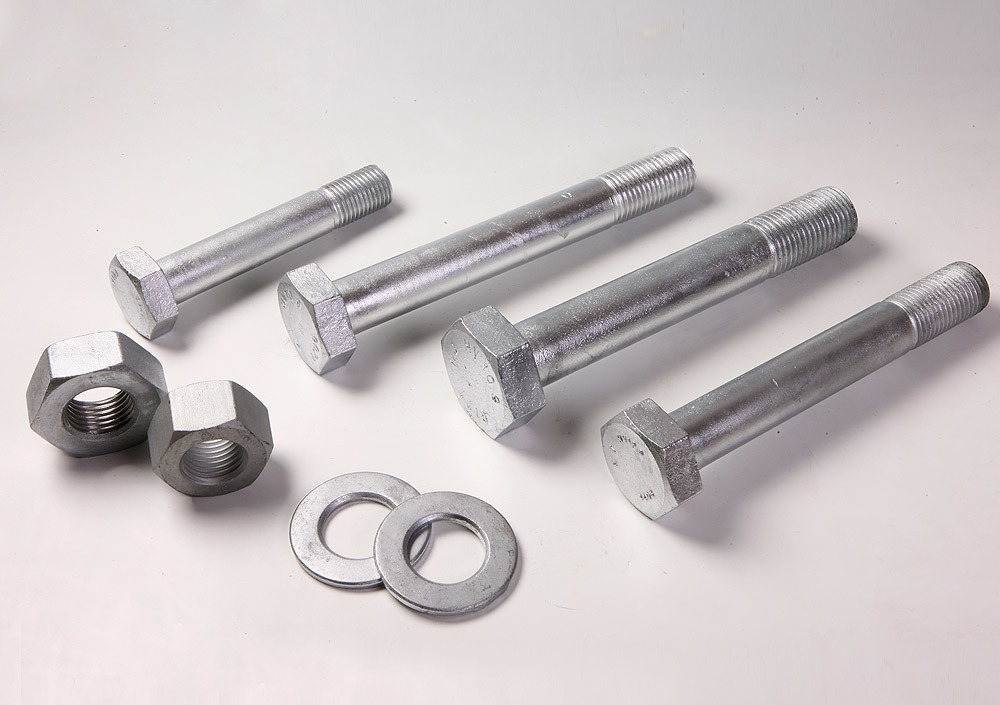
42CrMo4 (1.7228) Property Class 10.9 Bolts for Wind Tower Flanges & Foundations: Specification Guide
A wind turbine tower flange does not fail on the first windy day. It fails after twenty years of alternating bending, start-stop cycles and rotor imbalance loads — and when it does, the bolt that lets go is almost always a preloaded 10.9 high-strength bolt that was not manufactured, coated or tensioned to the right specification.
WF Fastener manufactures 42CrMo4 property class 10.9 bolts for wind tower ring-flange connections and foundation anchor systems for turbine manufacturers, EPC contractors and wind farm operators across Europe, the Middle East and Southeast Asia. Our production follows ISO and EN standards — ISO 898-1 for mechanical properties, EN 14399 for preloaded structural assemblies, ISO 10683 / ISO 10684 for coatings — with project-specific requirements mapped to turbine OEM drawings. This guide covers what 42CrMo4 actually is, why it is the default tower bolt material, and what a procurement engineer should check before approving a supplier.
WF Fastener 42CrMo4 Wind Bolt Quick Reference
- Material: 42CrMo4 / EN 1.7228 (AISI 4140 equivalent), quenched and tempered
- Property class: 10.9 per ISO 898-1 / EN ISO 898-1
- Assembly system: EN 14399-4 HV (heavy hex) or EN 14399-3 HR, as a matched bolt + nut + washer set
- Typical sizes: M30, M36, M39, M42 tower flange; M42–M64 foundation anchors
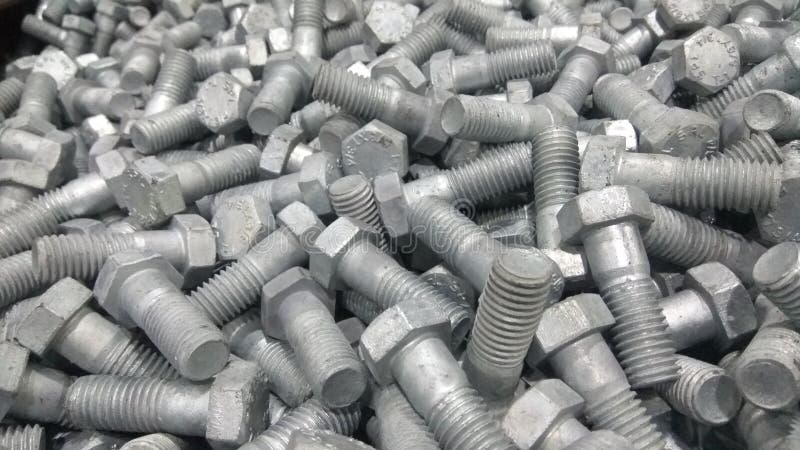
- Coating: zinc flake per ISO 10683 (low-hydrogen, controlled friction) or hot-dip galvanized per ISO 10684
- Threads: rolled after heat treatment (commonly specified for fatigue-critical tower bolts)
- Documentation: EN 10204 3.1, tensile / yield / hardness, impact at low temp, coating and friction records
1. What Is 42CrMo4 and Why Is It the Tower Bolt Standard?
42CrMo4 (material number 1.7228, roughly equivalent to AISI 4140) is a chromium-molybdenum alloy steel. Its chemistry puts about 0.40% carbon, 1.0% chromium and 0.2% molybdenum into the bar, which after quenching and tempering produces a tensile strength above 1000 MPa with enough toughness for fatigue service.
That heat-treated condition is what delivers property class 10.9 under ISO 898-1:
| Property (ISO 898-1, class 10.9) | Value |
|---|---|
| Nominal tensile strength | 1000 MPa |
| Minimum tensile strength | 1040 MPa |
| Minimum yield strength (Rp0.2) | 940 MPa |
| Proof load stress | 830 MPa |
| Hardness | 320–380 HV (approx. 33–39 HRC) |
| Elongation after fracture | 9% minimum |
The "10.9" designation means: 10 x 100 MPa nominal tensile, and 0.9 x that as the yield-to-tensile ratio. A 10.9 bolt can be preloaded to about 70% of its yield (roughly 0.7 x 940 MPa) and still retain a safe margin against yield under service overload. That high preload margin is exactly what a tower flange needs: the bolt is tensioned so the flange faces stay clamped in compression, and the cyclic wind loads act on the clamped joint rather than stretching the bolt.
Why 42CrMo4 and not a cheaper carbon steel? A standard 8.8 bolt gets about 640 MPa yield — not enough preload margin for a multi-decade fatigue joint on a 100-metre tower. A 12.9 bolt is stronger but more notch-sensitive and more susceptible to hydrogen embrittlement, which is why tower designs stay at 10.9. The chromium-molybdenum chemistry of 42CrMo4 gives the tempering resistance and toughness that 10.9 requires.
2. Where 42CrMo4 Bolts Go on a Wind Turbine
Two bolted positions dominate a wind turbine, and both use 42CrMo4 10.9:
Tower ring-flange connections
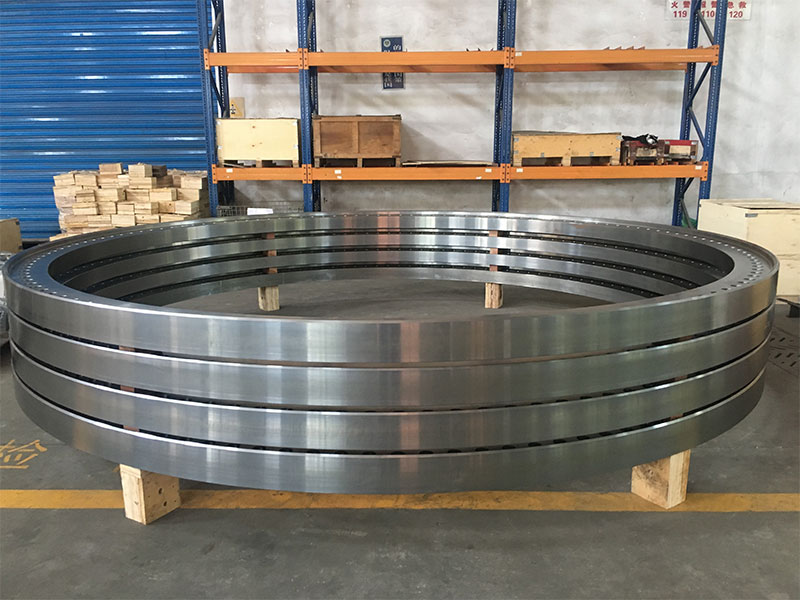
The tower is shipped in cylindrical sections 20–30 metres long, each ending in a machined ring flange. The sections are stacked and bolted circumferentially — typically 80–120 bolts per flange circle, depending on turbine size and tower diameter. These are large-diameter, long bolts, commonly M36 x 320 to M42 x 400 on multi-megawatt turbines, tensioned hydraulically or by torque-angle.
Foundation anchor connections
At the tower base, the tower flange bolts onto a foundation anchor system — either an embedded anchor cage with threaded rods and nuts, or a ring-anchor design. These bolts are larger still, M42 to M64, and many are embedded in concrete and grout. We cover the anchor cage and L-type / J-type design in detail in our wind turbine foundation anchor bolts guide. Wind foundations actually use several competing systems — 42CrMo4 10.9 anchor rods, proprietary anchor cages supplied by foundation vendors, post-tensioned rock- or pile-anchored designs, and cast-in-place ring foundations — and the bolting material is selected by the foundation engineer for each turbine class and site. Where 42CrMo4 10.9 is specified, the reason is that the foundation joint carries the overturning moment of the entire rotor and must remain preloaded for the design life.
Secondary positions — service platforms, cable clamps, internal ladder and access hardware — usually use lower classes (8.8 or stainless), but the main flange and foundation bolting is 10.9.
3. EN 14399: Why Tower Bolts Are Supplied as Assemblies
A wind tower bolt is not bought as a loose bolt. It is supplied as a qualified assembly — bolt, nut and washers from the same production lot, with the friction and preload behaviour tested together. In European and international wind projects this is the EN 14399 family:
- EN 14399-1: general requirements
- EN 14399-3: system HR — hex bolt + nut, standard hex head
- EN 14399-4: system HV — heavy hex head with larger across-flats, the classic tower flange system
- EN 14399-5 / -6: plain and chamfered hardened washers
- EN 14399-2: suitability for preloading — the core friction / preload test
The engineering point: EN 14399 is not simply a bolt dimension standard. It defines both the individual component requirements — material, geometry, tolerances and property class for the bolt (14399-3 / -4), nut (-5) and washers (-6) — and, in 14399-2, the suitability-for-preloading testing that the bolt + nut + washer assembly must pass together. The friction coefficient between bolt, nut, washer and coating is measured on a representative assembly, and the torque-preload table the erection crew uses is derived from that test. If you mix a 42CrMo4 bolt from one source with a nut and washers from another, or change the coating, the measured friction coefficient no longer applies and the torque table no longer produces the designed preload. Tower projects therefore specify and procure complete HV or HR assemblies.
For Chinese-spec towers on exported projects, the equivalent is GB/T 1228–1231 high-strength bolting; the same assembly logic applies.
For North American wind projects, the parallel compliance route is ASTM F3125 (which consolidates the former A325 and A490 high-strength structural bolt specifications) used under AISC / RCSC design provisions. EN 14399 HV assemblies and ASTM F3125 / A325 / A490 systems are not interchangeable: they use different geometry, coating and friction assumptions, and an HV set cannot be substituted onto a North American-spec tower flange without the engineer of record re-qualifying the joint.
4. Preload, Friction and the Coating Specification
Tower bolts are preloaded to roughly 70% of yield (0.7 x fyb), set by the turbine designer. The bolt is stretched so the flange faces remain compressed under all operating loads, and the bolt itself sees only a small alternating stress — which is what gives the joint its fatigue life.
Two things control how much torque converts into actual preload:
- The nut factor K in the relationship Torque = K x F x d. K depends on the coating, the lubricant, the thread condition and the washer surface.
- The friction coefficient, typically specified as a range (for example 0.12–0.16) on the drawing.
This is why the coating is part of the bolt specification, not an option:
| Coating | Standard | Friction behaviour | Notes for 10.9 tower bolts |
|---|---|---|---|
| Zinc flake (Geomet / Delta-Pro / Dacromet type) | ISO 10683 | Low, stable, defined range | Preferred for 10.9; low hydrogen embrittlement risk; thin film does not affect thread fit |
| Hot-dip galvanizing | ISO 10684 | Thicker, higher friction | Heavy corrosion protection; threads must be over-tapped or cut after galvanizing; friction scatter requires calibrated torque |
| Electroplated zinc | — | Uncontrolled | Restricted on 10.9 due to hydrogen embrittlement risk and friction scatter |
| Plain / phosphate oil | — | High, variable | Used indoors or where re-lubricated at assembly; not typical for external tower flanges |
We go into the coating trade-off in detail in our zinc-flake coated bolts guide. The practical rule for tower buyers: state the coating standard, the thickness range and the target friction coefficient on the inquiry, because the erection torque table is built around them.
5. Fatigue: Rolled Threads and Surface Quality
A 10.9 bolt is a fatigue component, not a static fastener. Thread rolling work-hardens the thread root and produces a continuous grain flow around the thread form, which directionally improves fatigue strength compared with cut threads. The magnitude of the improvement depends on thread geometry, preload, surface condition and the loading spectrum, and should be confirmed against the joint's fatigue analysis rather than treated as a fixed multiplier. On fatigue-critical tower flange bolts, threads are commonly rolled after quenching and tempering rather than cut or rolled before heat treatment.
Other fatigue controls on 42CrMo4 tower bolts:
- Under-head fillet radius — a larger rolled fillet reduces notch sensitivity under the bolt head.
- Surface decarburisation — bar stock must be inspected for surface decarburisation, which reduces fatigue strength at the thread root.
- Low-temperature impact — for cold-climate wind farms (Northern Europe, high-altitude sites), Charpy impact testing at -20 °C or -40 °C is specified, because 42CrMo4 has a ductile-to-brittle transition that must be verified.
- No electroplating — acid pickling and electroplating on 10.9 bolts introduces hydrogen and risks delayed brittle fracture.
These are not optional extras on a wind farm order; they are the difference between a bolt that lasts twenty years and one that cracks at the thread root within two.
6. Manufacturing Route at WF Fastener
A 42CrMo4 10.9 tower bolt follows a controlled production sequence:
- Bar stock control — 42CrMo4 / 1.7228 hot-rolled or peeled bar from certified European or domestic mills, with EN 10204 3.1 mill certificates verified on receipt. Chemistry checked by spectrometer; surface decarburisation inspected.
- Heading / forging — bolt heads hot- or cold-forged to the EN 14399 HV / HR head geometry.
- Quench and temper — austenitised, quenched, then tempered to hit the 320–380 HV band. Hardness checked per lot.
- Thread rolling after heat treatment — threads rolled onto the heat-treated bar, with roll geometry controlled for fatigue.
- Coating — zinc flake applied in a controlled-line process with bake-out for hydrogen relief; thickness and adhesion recorded. For HDG, threads over-tapped after galvanizing.
- Mechanical testing — tensile, yield, elongation and hardness per lot; impact at the project-specified temperature; friction / preload calibration on representative assemblies.
- Marking and traceability — property class and manufacturer mark rolled or stamped; heat number on the box label, traceable from bar to delivered bolt.
A recent example: a batch of M36 x 340 HV assemblies, 10.9, zinc-flake coated to ISO 10683 with a specified friction range, supplied for a Middle East onshore wind project with 3.1 certificates per heat and coating thickness records.
7. Documentation Wind Farm QA Expects
A tower bolt order is not a fast-commodity order. The supplier's test capability and documentation discipline are part of the product. The pack wind farm QA / EPC inspectors check:
- EN 10204 3.1 material certificate, per heat, with chemistry and mechanical properties
- Tensile, yield, elongation and hardness test reports
- Hardness readings within the 320–380 HV / 33–39 HRC band
- Charpy impact report at the project-specified temperature (e.g. -20 °C / -40 °C)
- Friction / preload calibration report for the coated assembly, with the measured friction coefficient range
- Coating thickness and adhesion records (zinc flake per ISO 10683, or HDG per ISO 10684)
- Thread rolling confirmation (rolled after heat treatment, not cut)
- Dimensional inspection: thread gauge fit, head geometry, length
- Lot traceability: heat number matching mill certificate to box labels
Third-party witness (SGS, BV, TÜV, DNV) is arranged on critical foundations; we hold lots for witness rather than shipping and certifying later.
8. Supplier Evaluation Card
When comparing 42CrMo4 tower bolt suppliers, use the points below. They reflect what wind farm procurement and turbine OEM QA teams ask for on qualification audits.
| Evaluation point | What to ask the supplier | Why it matters |
|---|---|---|
| Material traceability | Can every delivered bolt be traced to a 42CrMo4 / 1.7228 mill heat? | Untraceable "10.9" bolts fail tower project audit |
| Thread process | Are threads rolled after heat treatment? | Cut threads directionally reduce fatigue performance on tower joints |
| Assembly supply | Can they supply bolt + nut + washers as an EN 14399 HV set? | Mixed-source assemblies lose friction calibration |
| Friction data | Do they provide measured friction coefficient for the coating? | Without it, the erection torque table is guesswork |
| Low-temp impact | Can they test and report Charpy at -20 °C / -40 °C? | Cold-climate sites require verified toughness |
| Hydrogen control | Is zinc flake applied with a bake-out process? | 10.9 bolts are hydrogen-embrittlement-sensitive |
| Coating control | Is the coating line in-house or subcontracted? | Subcontracted coating often loses thickness / friction control |
| Repeat delivery | Can they reproduce the same lot for future phases? | Multi-phase wind farms need consistent bolt lots |
| Certificate format | 3.1 in English, per heat, matching the PO line items? | Owner inspectors reject non-conforming cert packs |
9. RFQ Dimensions: What to Send for a Complete Quotation
Wind tower bolt inquiries come back with clarifying questions when the assembly standard or friction requirement is missing. Send the following on the first request:
| RFQ field | Example | Notes |
|---|---|---|
| Position | Tower ring flange, or foundation anchor | Changes length and thread engagement |
| Assembly standard | EN 14399-4 HV, or EN 14399-3 HR | State the system, not just "10.9 bolt" |
| Property class | 10.9 per ISO 898-1 | Do not substitute 8.8 or 12.9 without approval |
| Size and length | M36 x 3 x 340 | Pitch and length per drawing |
| Nut and washers | Included as matched HV set | Required for assembly qualification |
| Coating | Zinc flake ISO 10683, or HDG ISO 10684 | State thickness range and friction target |
| Friction coefficient | e.g. 0.12–0.16 | Per turbine OEM specification |
| Impact requirement | Charpy at -20 °C, 27 J min | For cold-climate sites |
| Quantity | e.g. 2,400 sets per flange circle | Bolts and nuts counted as sets |
| Certification | EN 10204 3.1; 3.2 with TÜV witness if required | Agreed at quotation |
| Packaging | VCI, count per box, pallet labels | Erection crew counts on site |
Reply with these fields and we return a complete assembly quotation — bolt, nut, washers, coating, friction data and documentation — without a follow-up round trip.
10. Common Mistakes on Tower Bolt Orders
- Specifying "10.9 bolt" without the assembly standard. A loose 10.9 bolt is not an EN 14399 assembly; the nut, washers and friction behaviour are unqualified.
- Cut threads on fatigue-critical bolts. Cut-thread 10.9 bolts look identical but fail early in service. Always confirm post-heat-treatment rolling.
- Electroplated zinc on 10.9. Hydrogen embrittlement risk and uncontrolled friction. Use zinc flake.
- HDG without over-tap. The nut will not run onto the coated bolt thread, or will gall during tensioning.
- Changing coating without updating the torque table. A different coating changes K and the achieved preload. The erection procedure must be reissued.
- Reusing tower bolts. Preloaded 10.9 bolts that have been in service are work-hardened; re-tensioning them gives unpredictable preload. Replacement at scheduled maintenance uses new bolts.
For foundation positions, the embedded, inaccessible nature of anchor bolts adds a separate layer of control — covered in our foundation anchor bolts guide. For the broader renewable range, start at the renewable energy fastener manufacturer center.
FAQ
Q: What does 42CrMo4 mean as a bolt material?
A: 42CrMo4 (EN 1.7228, AISI 4140 equivalent) is a chromium-molybdenum alloy steel that, after quenching and tempering, delivers property class 10.9 under ISO 898-1. It is the standard material for wind tower flange and foundation bolts.
Q: Why are wind tower bolts 10.9 and not 8.8?
A: A 10.9 bolt yields at ~940 MPa, allowing preload to ~70% of yield with a safe margin. 8.8 bolts (~640 MPa yield) do not provide enough preload margin for a twenty-year fatigue joint on a loaded tower flange.
Q: Can I hot-dip galvanize 10.9 tower bolts?
A: It is possible, but HDG on 10.9 requires controlled process, over-tapped threads and friction recalibration. Zinc flake per ISO 10683 is the more common choice for preloaded 10.9 tower bolts because of lower hydrogen risk and stable friction.
Q: Why must threads be rolled after heat treatment?
A: Post-heat-treatment thread rolling produces a continuous grain flow and work-hardens the thread root, which directionally improves fatigue strength compared with cut threads; the actual benefit depends on thread geometry, preload, surface condition and loading. Cut threads or pre-heat-treatment rolling leave a notch at the thread root that is more likely to initiate fatigue cracks, which is why fatigue-critical tower bolts are commonly post-heat-treatment rolled.
Q: Do you supply the nuts and washers with the bolts?
A: Yes. Tower bolts are supplied as complete EN 14399 HV / HR assemblies — bolt, nut and washers from the same lot — with friction and preload calibration on the pack.
Q: What certificates are included?
A: EN 10204 3.1 per heat, tensile / yield / hardness, Charpy impact at the specified temperature, coating thickness and friction calibration records. 3.2 with third-party witness is arranged where the turbine OEM requires.
Request a Quotation
Send the RFQ dimensions above — or attach the turbine OEM bolting drawing — and we will confirm assembly supply, 42CrMo4 10.9 property class, coating and friction properties, preload calibration data and the full documentation pack for your wind farm project.
Email: engineering@wffastener.com
We supply complete tower flange and foundation bolt assemblies for onshore and offshore wind projects, with the test and certificate scope agreed at quotation so the delivered pack matches the commercial order.
Related guides: Renewable Energy Fastener Manufacturer Center, Wind Turbine Foundation Anchor Bolts, Zinc-Flake Coated Bolts