1. Introduction: Why Fastener Material Selection Matters in GCC Solar Projects
Utility-scale solar projects across the GCC region are designed for long operating periods, commonly 25 years or more. During this lifecycle, photovoltaic modules, tracker structures, and mounting hardware remain exposed to demanding environmental conditions including intense UV radiation, high temperatures, airborne dust, humidity changes, and coastal salt exposure.
For solar mounting systems, fasteners are small components by size but critical components by function. A failed bolt connection can affect structural stability, maintenance schedules, and long-term system reliability.
In many GCC projects, the initial focus is usually on module efficiency, inverter performance, and tracker technology. However, the mounting structure depends on thousands of fastener connections that must maintain mechanical performance throughout the project lifecycle.
The key question for project engineers and procurement teams is not simply:
"Which fastener material has the highest corrosion resistance?"
The more practical question is:
"Which fastener material provides the required corrosion protection and mechanical performance for the actual installation environment at the lowest total project cost?"
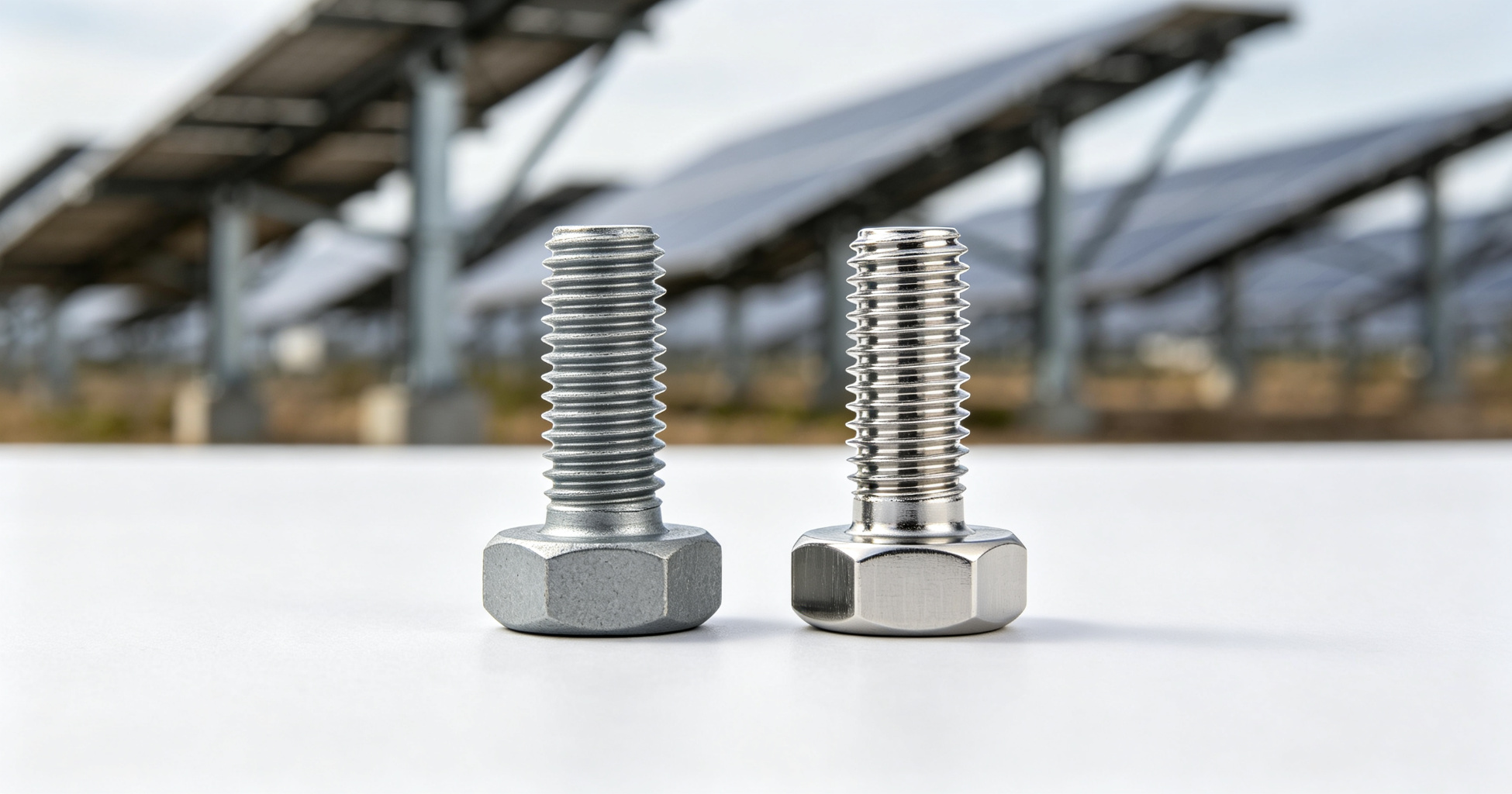
Two common choices for solar tracker applications are:
Zn-Al-Mg coated carbon steel fasteners
SS316 / A4-80 stainless steel fasteners
Both materials have advantages. Selecting the correct option depends on factors including corrosion category, project location, mechanical requirements, installation conditions, and maintenance expectations.
For GCC solar farms, this decision becomes especially important because environmental conditions vary significantly. A ground-mounted solar plant in an inland desert area has different requirements from a coastal project near the Red Sea or Arabian Gulf.
A properly selected fastener system can provide:
Long-term corrosion protection
Reliable preload retention
Faster installation
Reduced maintenance risk
Better balance between material cost and project performance
This article compares Zn-Al-Mg coated fasteners and SS316/A4-80 stainless steel fasteners from an engineering and procurement perspective, helping solar project teams select the right solution for different PV applications.
2. The GCC Environmental Challenge for Solar Fasteners
Understanding Corrosion Exposure Through ISO 12944 Classification
The GCC region contains some of the world's most challenging environments for outdoor steel structures. However, not every solar project faces the same corrosion risk.
The correct fastener specification should consider the actual environmental exposure rather than applying one material standard to every project.
The ISO 12944 corrosion classification system provides a practical reference for evaluating atmospheric corrosion conditions.
C3: Inland Desert Solar Sites
Many large solar developments are located in inland desert areas where the environment is characterized by:
Low annual rainfall
Low humidity for extended periods
High solar radiation
Significant temperature changes between day and night
Wind-blown dust and sand exposure
Although these locations may have lower salt exposure than coastal areas, fasteners still face challenges:
Dust accumulation around connections
Thermal expansion and contraction cycles
Abrasion from airborne particles
Localized moisture during rare rainfall events
For many inland PV projects, a properly specified Zn-Al-Mg coated fastener system can provide effective corrosion protection while maintaining cost efficiency.
C4: Arid Industrial Environments
Some solar projects are located near industrial zones, refineries, processing facilities, or expanding urban areas.
These environments may include:
Higher atmospheric pollutants
Industrial emissions
Increased humidity exposure
Temperature cycling
Fasteners in these locations require improved corrosion resistance compared with standard carbon steel protection systems.
Surface coating quality, coating thickness, and installation handling become important factors.
C5: High-Salinity Marine Environments
Coastal solar projects near the Red Sea and Arabian Gulf experience significantly more aggressive corrosion conditions.
Typical challenges include:
Salt spray deposition
Chloride contamination
High humidity
Accelerated corrosion at damaged coating areas
In these environments, corrosion often starts at:
Cut edges
Thread areas
Damaged coating points
Contact surfaces between different metals
For coastal PV projects, stainless steel fasteners such as SS316/A4-80 are often specified for critical connections where chloride resistance is a priority.
CX: Extreme Coastal Exposure
Some offshore, near-shore, and floating PV applications experience extreme marine exposure.
These locations may involve:
Continuous salt deposition
High humidity
Direct seawater influence
Difficult maintenance access
For these projects, material selection becomes more conservative. Stainless steel solutions, including SS316/A4-80, may be required for specific components such as module clamps, grounding connections, and exposed hardware.
Why Standard HDG Fasteners May Not Be Suitable for Every GCC Application
Hot-dip galvanized (HDG) fasteners are widely used because they provide economical corrosion protection. However, in higher corrosion environments, several limitations may appear.
Potential issues include:
Cut-edge corrosion
When coating damage occurs during manufacturing, installation, or handling, exposed steel areas can become corrosion initiation points.
White rust formation
Zinc surfaces can develop white corrosion products under certain moisture conditions, especially during storage or transportation.
Thread-related issues
Coating damage or corrosion products in threaded areas may affect assembly performance.
Bolt seizure and installation problems
Surface condition, coating thickness variation, and environmental exposure can influence tightening performance.
For this reason, selecting between HDG, Zn-Al-Mg coated fasteners, and stainless steel requires consideration of the complete application rather than only the coating type.
3. What Are Zn-Al-Mg Coated Fasteners?
Understanding the Coating Technology
Zn-Al-Mg coated fasteners are carbon steel fasteners protected by an advanced zinc-aluminum-magnesium alloy coating.
The coating composition typically contains:
Zinc (Zn) as the primary element
Approximately 6–11% aluminum (Al)
Approximately 3% magnesium (Mg)
The exact composition depends on the coating system manufacturer and specification.
A common misunderstanding is confusing Zn-Al-Mg coatings with Galvalume.
They are different technologies.
Zn-Al-Mg coating:
Designed for corrosion protection of steel components
Commonly applied to fasteners, structural parts, and mounting hardware
Uses zinc with aluminum and magnesium additions to improve corrosion performance
Galvalume coating:
Typically refers to sheet products
Uses approximately 55% aluminum, zinc, and silicon
Commonly used for roofing and steel sheet applications
A Galvalume sheet specification should not automatically be applied to solar fastener requirements.
Self-Healing Protection at Cut Edges
One major advantage of Zn-Al-Mg coatings is improved protection at damaged areas.
When the coating surface is scratched or cut, corrosion products containing aluminum and magnesium compounds can migrate and help form a more stable protective layer.
This provides improved edge protection compared with conventional zinc coatings.
For solar mounting systems, this characteristic is valuable because fasteners experience:
Thread contact during installation
Tool handling
Transportation impacts
Assembly friction
Corrosion Test Performance
Zn-Al-Mg coatings have demonstrated improved corrosion resistance compared with conventional galvanized coatings in accelerated corrosion testing.
Common evaluation methods include:
ASTM B117 salt spray testing
ISO 9227 corrosion testing
Cyclic corrosion testing according to applicable project requirements
Some Zn-Al-Mg coating systems achieve significantly longer salt spray performance than traditional HDG systems, with reported results exceeding 3000 hours under ASTM B117 testing conditions.
However, accelerated test results should always be evaluated together with:
Coating thickness
Substrate preparation
Manufacturing process
Real project exposure conditions
A laboratory salt spray result alone should not replace engineering evaluation.
4. SS316 (A4-80) vs Zn-Al-Mg: Head-to-Head Comparison
Choosing between Zn-Al-Mg coated fasteners and SS316/A4-80 stainless steel depends on project requirements.
Neither material is universally better.
The correct selection depends on corrosion exposure, mechanical loading, installation requirements, and total project economics.
Factor Zn-Al-Mg Coated Fasteners SS316 / A4-80 Stainless Steel
Base Material Carbon steel with Zn-Al-Mg protective coating Austenitic stainless steel
Typical Application Solar tracker structures, purlins, structural connections Coastal hardware, exposed clamps, special connections
Corrosion Performance Suitable for many C3-C4 environments and selected higher exposure applications based on specification Excellent chloride resistance for C5/CX marine environments
Initial Material Cost Typically lower; often 30–40% lower than A4-80 depending on specification Higher material cost
Mechanical Strength High-strength carbon steel grades available Good corrosion resistance but generally higher cost for equivalent strength
Installation Risk Lower galling risk during tightening Higher galling tendency requiring installation control
Thread Performance Coating system must be controlled for friction consistency Requires attention to lubrication and torque control
Abrasion Resistance Good when coating system is properly selected Excellent corrosion resistance but surface damage can affect appearance
Supply Availability Widely available for solar structural applications Available but higher cost and longer sourcing considerations in some projects
Lifecycle Cost Often favorable for inland utility-scale projects Favorable for severe marine and critical exposed applications
For many GCC utility-scale solar projects, the most practical solution is not selecting one material for every component.
A hybrid strategy is often used:
Zn-Al-Mg coated fasteners for primary structural connections
SS316/A4-80 fasteners for exposed marine components and critical assemblies
The following sections will examine where each material should be specified, common procurement mistakes, and how solar project teams can evaluate fastener suppliers.
5. Where to Use Which: Engineering Specification Guide
Selecting between Zn-Al-Mg coated fasteners and SS316/A4-80 stainless steel should begin with the actual project environment and connection requirements.
A common mistake in solar procurement is specifying one fastener material for the entire project without considering that different parts of a PV mounting system experience different loads and exposure conditions.
The mounting structure, tracker components, module clamps, and grounding points do not always require the same material solution.
Zn-Al-Mg Fasteners: Recommended for C3-C4 Inland Solar Applications
For many inland GCC solar farms, Zn-Al-Mg coated fasteners provide an effective balance between corrosion protection, mechanical performance, and project cost.
Typical applications include:
Tracker torque tube connections
Tracker systems operate through repeated movement cycles. Structural fasteners must maintain preload while resisting environmental exposure.
Zn-Al-Mg coated high-strength fasteners can provide:
High tensile strength
Stable mechanical performance
Lower installation risk compared with stainless steel
Cost advantages for large quantities
Purlin and structural frame connections
Large utility-scale PV plants may require hundreds of thousands or millions of fasteners.
Using SS316 across all structural connections can significantly increase balance-of-system (BOS) costs without necessarily improving project reliability in lower corrosion environments.
Zn-Al-Mg fasteners are commonly considered for:
Ground-mount racking structures
Rail connections
Structural brackets
Equipment support frames
SS316 / A4-80: Required for Severe Marine and Critical Applications
SS316/A4-80 stainless steel fasteners provide superior resistance to chloride environments and are commonly selected where corrosion exposure is severe.
Typical applications include:
Coastal PV projects
Solar farms near:
Arabian Gulf coastline
Red Sea coastline
High-salinity marine areas
may require stainless steel solutions for exposed components.
Floating PV systems
Floating solar installations face continuous moisture exposure and potentially aggressive marine conditions.
Fastener selection should consider:
Water exposure
Chloride concentration
Maintenance accessibility
Long-term corrosion consequences
Grounding and electrical connections
Grounding components require reliable electrical continuity throughout the project lifecycle.
SS316 stainless steel is often preferred for:
Grounding clamps
Bonding components
Exposed electrical connections
Hybrid Fastener Strategy for Utility-Scale Solar Projects
For many GCC projects, the most practical engineering approach is a combination of materials.
Example:
Component Recommended Material
Tracker structural bolts Zn-Al-Mg coated fasteners
Torque tube connections Zn-Al-Mg coated fasteners
Structural frame joints Zn-Al-Mg coated fasteners
Module clamps in coastal areas SS316/A4-80
Grounding clamps SS316
High-exposure external hardware SS316/A4-80
This approach avoids unnecessary material overspecification while maintaining reliability in critical locations.
6. Common Sourcing Mistakes When Selecting Solar Fasteners
Mistake 1: Specifying Only Salt Spray Hours Without Reviewing Full Corrosion Data
A common procurement requirement is:
"Provide fasteners with 3000-hour salt spray resistance."
However, ASTM B117 salt spray results alone do not represent every real installation condition.
Project teams should also review:
Corrosion test method
Coating thickness
Coating weight
Surface preparation
Cyclic corrosion testing results
Actual project exposure classification
A fastener supplier should be able to explain how laboratory testing relates to the expected GCC environment.
Mistake 2: Ignoring Galling Risk With A4-80 Stainless Fasteners
SS316/A4-80 provides excellent corrosion resistance, but stainless steel threads require proper installation control.
A4-80 fasteners can experience galling due to:
High friction between stainless surfaces
Excessive tightening speed
Incorrect torque settings
Poor lubrication practice
On large solar projects, galling can create installation delays because seized bolts may require replacement.
Proper solutions include:
Controlled tightening procedures
Suitable anti-seize compounds when specified
Correct torque-tension verification
Mistake 3: Confusing Galvalume Specifications With Zn-Al-Mg Fasteners
This is a frequent technical misunderstanding.
Galvalume sheet products and Zn-Al-Mg coated fasteners are different products with different coating systems.
A solar mounting supplier should verify:
Actual coating composition
Coating thickness
Manufacturing process
Applicable corrosion test data
A roofing sheet specification cannot automatically define fastener performance.
Mistake 4: Over-Specifying Full SS316 Hardware for Inland Desert Projects
Using stainless steel everywhere may appear to reduce corrosion risk, but it can create unnecessary cost.
For large-scale solar farms, thousands of additional kilograms of stainless steel can significantly increase BOS costs.
A better approach is:
Identify corrosion zones
Classify connection requirements
Select suitable materials by application
Engineering decisions should balance reliability and lifecycle economics.
Mistake 5: Not Verifying Coating Condition After Thread Manufacturing
Fastener production involves multiple processes:
Heading
Thread rolling
Machining
Coating
Inspection
The final thread condition must be checked because coating thickness and surface condition affect:
Assembly performance
Torque relationship
Corrosion protection
A qualified supplier should verify:
Thread dimensions
Coating thickness
Surface condition
Batch consistency
7. How wffastener Supports Solar Hardware Projects
wffastener.com focuses on supplying solar mounting hardware and customized fastener solutions for PV projects in the GCC and international markets.
Solar projects often require more than standard catalog bolts. Different tracker designs, mounting structures, and installation environments require fasteners manufactured according to engineering requirements.
Custom Fasteners According to Drawings
wffastener supports OEM and project-based requirements including:
Custom dimensions
Special thread specifications
Drawing-based production
Prototype samples
Production batches
The engineering process typically includes:
Drawing review →
Material confirmation →
Manufacturing feasibility check →
Sample approval →
Mass production →
Inspection and shipment
SS316 / A4-80 Fastener Capability
For projects requiring stainless steel solutions, wffastener can support:
SS316 fasteners
A4-80 high-strength stainless fasteners
Solar clamps
Grounding hardware
Corrosion-resistant mounting components
Material selection is reviewed according to:
Project environment
Mechanical requirements
Installation conditions
Zn-Al-Mg Coated Fastener Manufacturing
For utility-scale solar applications where cost-performance balance is important, Zn-Al-Mg coated fasteners provide an alternative to full stainless steel solutions.
Important manufacturing considerations include:
Coating compatibility
Thread accuracy
Friction consistency
Batch traceability
Thread processing and coating sequence must be carefully controlled to ensure the finished fastener meets installation requirements.
Quality Documentation and Traceability
Solar EPC projects increasingly require complete documentation packages.
wffastener can support documentation including:
EN 10204 3.1 material certificates
Chemical composition reports
Mechanical test reports
Coating inspection records
Dimensional inspection reports
Batch traceability documentation
Each production batch should be traceable from raw material through finished shipment.
Sample Approval Process
Before large production orders, many solar customers require sample evaluation.
A typical approval process includes:
Drawing confirmation
Material verification
Sample production
Dimensional inspection
Performance review
Customer approval
Mass production
This reduces project risk before full-scale supply.
8. Evaluating a Solar Fastener Supplier
Selecting a fastener supplier requires more than comparing unit prices.
For solar projects, supplier capability should be evaluated through technical documentation, manufacturing control, and communication efficiency.
Pre-RFQ Technical Checklist
Before requesting a quotation, confirm:
Material Capability
Can the supplier provide Zn-Al-Mg coated fasteners?
Can they supply SS316/A4-80 products?
Can they recommend materials based on project environment?
Manufacturing Capability
Can they manufacture according to drawings?
Do they control thread production?
Can they maintain batch consistency?
Testing Capability
Request information about:
Coating thickness testing
Corrosion test reports
Torque-tension testing
Dimensional inspection
Documentation Checklist
A professional solar fastener supplier should be able to provide:
EN 10204 3.1 MTC
ISO 9227 corrosion test reports where applicable
Cyclic corrosion testing data when required
Coating inspection reports
Dimensional inspection records
Packing and batch identification records
Sample Evaluation Checklist
Before approving production, review:
✓ Material certificate matches supplied material
✓ Dimensions meet drawings
✓ Thread quality is acceptable
✓ Coating condition is consistent
✓ Installation torque requirements are confirmed
✓ Packaging protects coating during transportation
For GCC solar projects, a reliable fastener supplier is not only a manufacturer. The supplier becomes part of the engineering chain, helping ensure that every connection performs throughout the project lifecycle.
9. Conclusion: Selecting the Right Fastener Material for GCC Solar Projects
For solar tracker and mounting system projects, fastener selection should be based on environmental exposure, mechanical requirements, and total lifecycle cost — not simply the lowest purchase price or the highest corrosion rating.
Zn-Al-Mg coated fasteners and SS316/A4-80 stainless steel fasteners each have specific advantages.
For inland GCC solar farms operating in C3-C4 environments, Zn-Al-Mg coated fasteners can provide an effective balance of:
Corrosion protection
High mechanical strength
Lower installation risk
Better cost efficiency for large-scale projects
For coastal and high-salinity applications classified as C5 or CX, SS316/A4-80 stainless steel remains an important solution for exposed and critical components where chloride resistance is the priority.
The most effective approach for many utility-scale PV projects is not selecting one material for every connection. A hybrid strategy allows engineers to match fastener materials with actual operating conditions:
Zn-Al-Mg coated fasteners for primary structural connections
SS316/A4-80 fasteners for marine-exposed hardware, grounding components, and critical assemblies
Before approving any solar fastener supplier, project teams should evaluate more than material specifications. Manufacturing capability, coating control, traceability, inspection records, and technical support all influence long-term project reliability.
A correctly specified fastener system helps solar projects achieve stable performance throughout their planned operating life while avoiding unnecessary BOS cost increases.
The right material choice is not about selecting the most expensive option. It is about selecting the correct solution for the environment, application, and project requirements.
10. Tiered CTAs: Solar Fastener Engineering Support
Tier 1: Download GCC Solar Fastener Corrosion & Material Selection Matrix
Receive a practical reference covering:
ISO 12944 corrosion classification for GCC solar environments
Zn-Al-Mg vs SS316 material selection guidance
Inland desert vs coastal application recommendations
Common fastener specification mistakes
Procurement checklist for PV projects
Tier 2: Request Solar Fastener Sample Evaluation Package
For engineering teams comparing suppliers, request a sample evaluation package including:
Product samples
EN 10204 3.1 material certificate
Chemical composition report
Mechanical test data
Coating inspection records
Corrosion test documentation where applicable
Dimensional inspection report
Evaluate fastener performance before moving to full project production.
Tier 3: Submit Solar Tracker Drawings for Custom Fastener Quotation
wffastener supports custom solar fastener manufacturing according to customer drawings and project requirements.
Submit:
Fastener drawings
Material requirements
Surface treatment specifications
Project quantity
Delivery schedule
Our engineering team can review:
Material suitability
Manufacturing feasibility
Production requirements
Documentation scope
11. FAQ: Solar Fastener Material Selection for GCC PV Projects
Q1: What is the difference between Zn-Al-Mg coated fasteners and standard HDG fasteners?
Zn-Al-Mg coated fasteners use a zinc-aluminum-magnesium alloy coating designed to improve corrosion protection, especially at damaged areas and cut edges.
Compared with conventional hot-dip galvanized fasteners, Zn-Al-Mg coatings can provide improved corrosion performance in accelerated testing. Actual performance depends on coating thickness, manufacturing quality, installation conditions, and project environment.
Q2: Why do A4-80 stainless steel bolts experience galling during solar tracker installation?
A4-80 stainless steel fasteners provide excellent corrosion resistance, but stainless steel threads can have higher friction and a greater risk of galling compared with coated carbon steel fasteners.
Galling risk can be reduced through:
Proper torque control
Correct installation procedures
Suitable lubrication when specified
Thread quality control
For large solar installations, installation performance should be considered together with corrosion resistance.
Q3: Can Zn-Al-Mg coated fasteners be used near the Red Sea or Arabian Gulf coast?
The answer depends on the specific project environment and engineering specification.
For severe marine environments classified as C5 or CX, SS316/A4-80 may be preferred for exposed and critical connections.
Zn-Al-Mg coated fasteners may be considered for certain higher-exposure applications when supported by appropriate corrosion testing and project requirements.
Q4: How does Zn-Al-Mg provide protection at cut edges and damaged areas?
Zn-Al-Mg coatings contain aluminum and magnesium elements that contribute to the formation of protective corrosion products.
These products can help slow corrosion progression around exposed areas compared with conventional zinc coatings.
However, coating performance still depends on manufacturing quality, coating thickness, and installation handling.
Q5: What documents should a solar fastener supplier provide for GCC PV projects?
A qualified supplier should be able to provide documentation such as:
EN 10204 3.1 material certificates
Chemical composition reports
Mechanical test reports
Coating inspection records
Corrosion test reports when required
Dimensional inspection reports
Batch traceability records
For utility-scale solar projects, documentation quality is an important part of supplier evaluation because every fastener batch must be traceable and verified before installation.
Zn-Al-Mg Coated Fasteners vs Stainless Steel: Cost-Performance Analysis for Solar Trackers
2026-09-17
Solar PV Mounting Hardware
Category:
Solar PV Mounting Hardware